

Shipping companies expect growth in 2026
2025 has been a year of uncertainty for cargo shipping companies, as growth has been lower than expected. New developments are on the horizon, particularly in digital services, and the green transition is gradually having an increasing impact on operations.
This time last year, Harri Tamminen, Vice President of Viking Line Cargo, was confident that 2025 would be a favourable year for Finland’s foreign trade.
“I expected the market to turn around at the beginning of this year, or during the first quarter at the latest, but that hasn’t happened,” says Tamminen.
“I believe that we’ll see an improvement in Finland’s foreign trade and an increase in consumer demand in Finland at some point next year. Which means that import shipments will also start to grow.”
Tamminen says that the cost level for cargo has lagged behind general trends in cost levels. There are clear price pressures.
“The current price level isn’t sustainable in the long run. I assume that road transport is in a similar position. If there’s a shortage of goods, price negotiations will naturally be necessary.”
Tamminen says that Viking Line’s customers are interested in environmental issues.
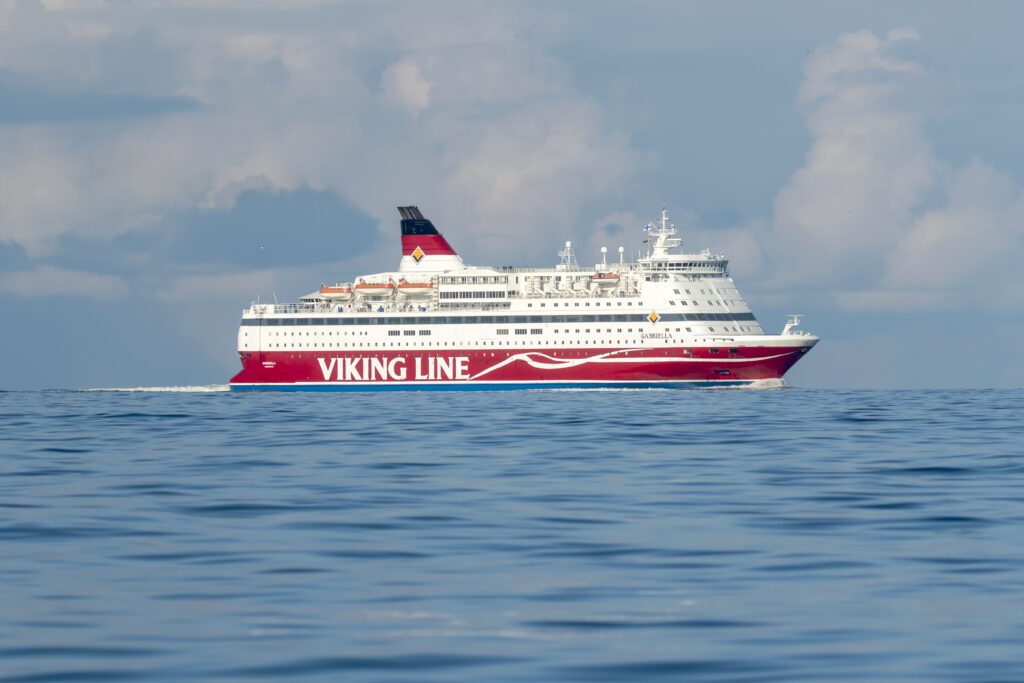
“In early September, we launched a new product that enables customers to buy a completely fossil-free crossing on all of our routes. It includes a small marginal price premium.”
If customers are willing to pay for a fossil-free crossing, Tamminen suggests that ports could take this into account by supporting operators that offer these kinds of solutions. “Helsinki’s harbours play a central role in Finland’s foreign trade. We hope that policymakers will develop more flexible transport infrastructure between ports and the Finnish road network.”
A good year in spite of the uncertainty
“This is a challenging situation for our customers, as US tariffs and general geopolitical uncertainty are generating instability in their operations,” says Satu Lindeberg, Managing Director of A.P. Moller-Maersk Finland.
According to Maersk, the Finnish cargo market is currently coloured by caution, which is being reflected in both import and export volumes. Volumes have been volatile and demand weaker in the forestry industry in particular, and especially in the pulp sector. A reduction in paper usage has also affected the paper industry in general.
“However, the year as a whole has been good. The Gemini project, which began in early 2025, has gotten off to a great start,” says Lindeberg.
The Gemini project is a strategic partnership between Maersk and Hapag-Lloyd, and is seeking reliable and efficient connections on East-West trade routes.
“At Maersk, we have achieved what we set out to achieve globally: schedule reliability has risen to over 90 per cent, which was our goal. Customers have also noticed the difference – shipments now arrive on time more often than before.”
Maersk sees the current global upheaval in supply chains as a phase, not a crisis.
“Supply chains are built over decades, and it takes time and cooperation to renew them. Success comes from flexibility, not isolation.”
Lindeberg shares the view that supply chain predictability and closer cooperation are also key in Finland. Customers value stability and reliability more than ever. Lindeberg hopes that the coming year will bring momentum to the cargo market.
“If the world’s conflicts were resolved and rebuilding could begin in Ukraine, this would also send a positive signal to maritime transport and the entire logistics sector. It would also allow a safer return to the sea route through the Suez Canal.
Environmental responsibility is a growing theme, but putting it into practice still requires a change in attitude.” “Customers in Finland are interested in green alternatives, but price is still a strong driver in theirdecision-making. We have seen that many customers in Sweden already prefer a green solution first and foremost. Finland is only just beginning to move in that direction,” says Lindeberg.

Things are looking up
Cargo traffic has decreased by 6.5 per cent on the Helsinki–Tallinn route, but things are looking up.
“Eckerö Line’s cargo traffic has remained at a good level. The number of cargo units has been increasing throughout the year,” says Tomas Sjödahl, Cargo Director.
However, no major growth is yet in sight.
“Expectations for next year’s cargo market are not much brighter overall. My guess is that we’re in for a very similar year to both this and last year.”
Sjödahl says that there is an imbalance in the market. Exports from Finland are quite strong, but imports have stagnated.
“Imports of construction materials have been down. We have seen a clear reduction in certain types of project deliveries, such as overwidth and overlength shipments.”
The pressure on shipping companies has been increasing all the time, and that increases costs. Sjödahl suspects that the costs arising from emissions trading cannot be fully passed on to customers.
“The Wärtsilä battery that is being installed on M/S Finlandia in January 2026 is a major investment in more sustainable shipping. Our aim is to switch to a fully electric fleet in the future. With the installation of this battery, M/S Finlandia will become the first hybrid ship in the Gulf of Finland. The vessel will use battery power when approaching and leaving a port, and also while at port. We’re targeting an aproximately three per cent reduction in fuel consumption, meaning that the ship will use around 500–600 tonnes less fuel per year. Our greenhouse gas emissions will also decrease. This is the first step on our journey towards fully electric and sustainable shipping.” “We have a good dialogue with the Port of Helsinki. Infrastructure development is really important for us to be able to maintain smooth-running traffic. The port is investing in a broad range of digital services, gateway solutions and digital displays. This also enables us to invest in a variety of solutions, such as faster outward clearance solutions.”

A challenging year ahead
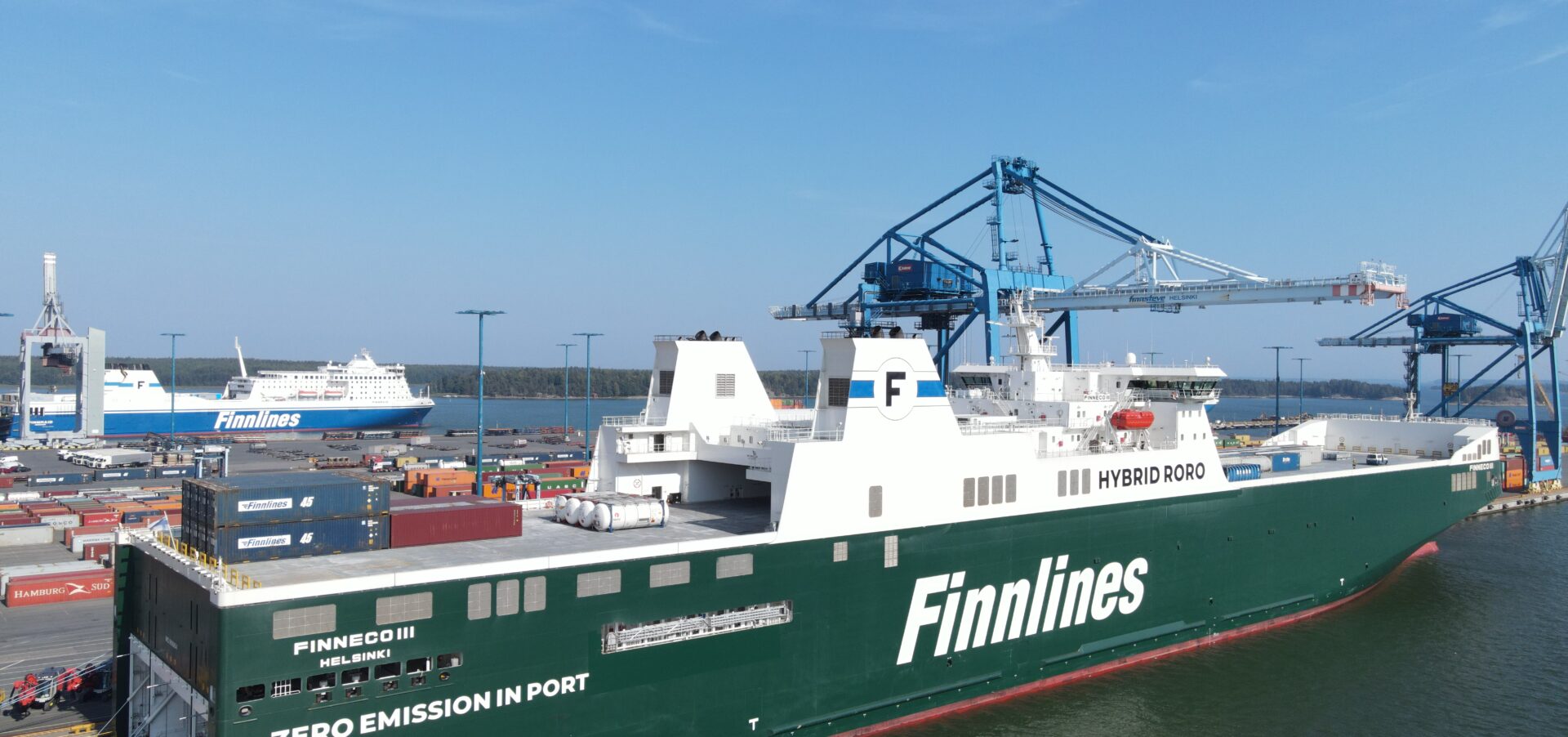
Finnlines has coped fairly well with the past year.
“For example, traffic on the Helsinki–Travemünde route has increased by 5.9 per cent on last year. This constitutes a significant increase in this kind of market. Many of our customers want their cargo to arrive and depart from Helsinki, so location is an essential factor for us,” says Merja Kallio-Mannila, Commercial Director at Finnlines.
The biggest upcoming change for their customers, and in fact all companies engaging in foreign trade, will be an increase in emissions trading allowances from 70 per cent this year to a hundred per cent in 2026.
“What’s new is that while emissions trading allowances were previously calculated on the basis of carbon dioxide emissions, from next year onwards, the formula will also include greenhouse gas emissions from methane and nitrous oxide. The increase to a hundred per cent translates to a rise of 43.9 per cent, but taking the new greenhouse gas emissions into account, the rise on current emissions trading prices is estimated at around 48 per cent.”
Finnlines also has something good to look forward to next year.
“For example, our Green Lane service offers customers the opportunity to use low-emission shipping. We can offer biofuel on all of our routes, and completely emission-free electricity for traffic between Finland and Sweden. Ships will also connect to shore power during port calls.”
Although few customers have yet had the financial means to join the service, Kallio-Mannila believes that it will take off once emissions trading prices rise, as the additional costs will be relatively small in 2026.
In Helsinki, Finnlines’ stevedoring company Finnsteve is offering its customers Gateway 24/7 – a new app that enables customers and their drivers to arrive at Vuosaari Harbour at virtually any time.
“This is a huge improvement on the current service. The gate is, for example, currently open for five hours on Sundays, but it will now be possible to drop off or collect a trailer unit at any time.”
Finnlines has also updated its Extranet service for several routes, including Helsinki–Travemünde, and the company’s ro-ro vessels will now be included as well.
Environmental issues topical
There is fierce competition in the cargo market, and maintaining profitable operations is a constant balancing act, says Marina Hasselblatt, Head of Cargo Sales at Tallink Silja.
“Our current routes, vessels and timetables will remain unchanged in spite of the challenges. This will enable us to offer our cargo customers fast and flexible crossings.”
Hasselblatt says that cost levels have risen significantly in recent years.
“As a result, transport companies are still feeling price pressures and profitability is low.”
Consumer demand has affected the products carried by Tallink Silja. Hasselblatt says that imports consist mainly of consumer goods, and it is imports in particular that have decreased, from both Estonia and Sweden.
“This is a direct result of economic uncertainty and cautious consumer behaviour.”
The outward clearance app that is already being used by transport companies will be further developed and extended to new users. It will speed up clearance processes and reduce emissions by cutting down on idling and queuing.
Hasselblatt says that environmental issues are currently very topical and much discussed.
“Environmentally friendly solutions are something that we all want. We operate very environmentally friendly vessels between Helsinki and Tallinn, and are already using Bio LNG to the extent that it is available.”